


What would you do if your CEO called you on a video conference and asked you to wire funds immediately?
Most people would do it.
That's exactly what happened to a finance worker at a multinational company in early 2024. Every person on that video call, including the CFO, was a deepfake. The company lost $25 million before anyone realized what had happened.
What Is Deepfake Fraud?
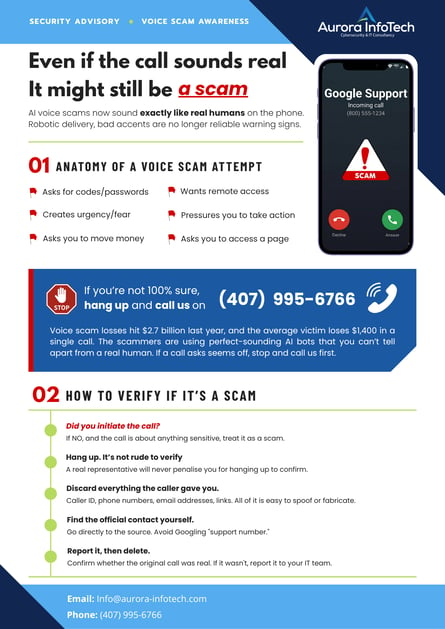
Deepfake fraud uses AI-generated audio or video to impersonate real people, like executives, vendors, colleagues, or IT staff, to manipulate employees into taking action.
It's no longer a future threat. The tools to create convincing deepfakes are widely available, increasingly affordable, and require very little technical expertise to use.
For businesses, the risk is straightforward: if an attacker can convincingly replicate a trusted voice or face, your team's instinct to trust what they see and hear becomes a vulnerability.
Where Businesses Are Most Exposed
Executive impersonation on calls
Attackers use AI-cloned audio or video to impersonate a CEO or senior leader, requesting urgent wire transfers, access credentials, or confidential information.
Fake vendor verification calls
A deepfake audio call appears to come from a known vendor confirming updated payment details — adding a layer of false credibility to what is already a common BEC tactic.
Fabricated video meetings
As seen in the 2024 case, entire video conferences can be staged using deepfake technology. Employees have no reason to question what looks and sounds completely real.
Cybersecurity Tip: How to Reduce Your Deepfake Fraud Risk
1. Establish verbal codewords for high-value requests
Agree on a safe word or phrase within your team that must be used to verify any request involving payments or sensitive access — something an AI impersonation wouldn't know.
2. Never approve financial transactions based on a call or video alone
Always follow up through a second, independent channel before acting on any payment or access request, regardless of who appears to be asking.
3. Limit publicly available audio and video of your leadership team
Deepfakes are trained on existing content. The less material available publicly, the harder it is to build a convincing imitation.
4. Include deepfake awareness in your security training
Your team needs to know this threat exists and what to do when something feels off, even if they can't immediately explain why.
Aurora InfoTech Is Here to Support You
At Aurora InfoTech, we are dedicated to assisting businesses in enhancing their Cybersecurity defenses.
With our team of experts and comprehensive solutions, we help ensure your systems and data are protected against evolving cyber threats.





.png?width=520&height=294&name=AIT%20Blog%20Post%20-%20Featured%20Images%20(15).png)