

 It can be easy to believe that enabling Multi-Factor Authentication (MFA) removes the risk of facing a cyberattack.
And in many cases, MFA does help prevent credential-based attacks.
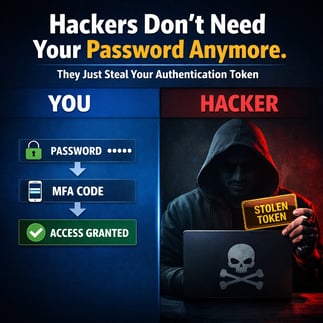
However, cybercriminals have evolved their methods, and one of the fastest-growing attack techniques today is called Token Theft.
And it allows attackers to bypass MFA protections entirely.
What is Token Theft?
When a user successfully logs into a system like Microsoft 365, Google Workspace, or another cloud platform, the system generates an authentication token.
This token acts as proof that the user has already authenticated.
Instead of forcing the user to repeatedly enter their password and MFA code, the token allows the system to maintain a secure session.
This improves usability and efficiency.
However, if an attacker steals that token, they can reuse it to access the account without needing the password or MFA code again, using a technique known as session hijacking.
How Cybercriminals Steal Authentication Tokens
Attackers commonly obtain authentication tokens through several methods:
Phishing Attacks: Attackers trick users into logging into a fake website designed to capture authentication data and session tokens. These websites often look identical to legitimate Microsoft or Google login pages.
Malware Infections: Malicious software installed on a device can extract authentication tokens stored in the browser. Once stolen, attackers can use the tokens to access cloud systems remotely.
Man-in-the-Middle Attacks: Attackers intercept authentication traffic between the user and the system, capturing session tokens during the login process.
Malicious Browser Extensions: Certain browser plugins can capture sensitive authentication data if users unknowingly install compromised extensions.
Why MFA Alone Does Not Stop Token Theft
Multi-Factor Authentication verifies a user's identity during login.
Token theft occurs after authentication has already been completed.
Because the session token already proves authentication occurred, systems allow continued access without requesting MFA again.
This means attackers can reuse the stolen token to access systems as if they were the legitimate user.
What Attackers Can Do Once Inside
When attackers gain access through token theft, they often focus on high-value targets such as email accounts.
Once inside, attackers may:
• Read confidential communications
• Download sensitive data
• Send fraudulent payment instructions
• Create hidden inbox rules to hide activity
• Launch internal phishing attacks against employees
In many cases, attackers remain undetected for weeks.
Real-World Impact
Organizations frequently discover token theft incidents only after financial fraud occurs.
In one recent example, a manufacturing company experienced a breach where:
• MFA was enabled
• Password policies were strong
• Security alerts never triggered
Attackers stole the authentication token and accessed the CEO’s mailbox.
They monitored communications for several days before sending payment instructions to a vendor.
The vendor nearly transferred $180,000 before realizing the email was fraudulent.
How Businesses Can Protect Themselves
Stopping token theft requires modern identity-focused cybersecurity practices.
Key protections include:
Conditional Access Policies - Require additional authentication checks based on location, device, and behavior.
Session Monitoring - Detect abnormal session activity that may indicate hijacking.
Endpoint Security - Prevent malware from stealing authentication tokens.
Identity Threat Detection - Monitor cloud identities for suspicious behavior.
Secure Browser Controls - Limit browser extensions and secure authentication sessions.
The Bottom Line
Passwords are no longer the primary target for cybercriminals.
Authentication sessions and identity tokens are.
Organizations must move beyond basic security tools and implement identity-focused cybersecurity strategies.
Aurora InfoTech helps healthcare practices and manufacturing companies secure their cloud identities and prevent advanced cyberattacks.
If your organization relies on Microsoft 365, cloud platforms, or remote access systems, understanding how attackers bypass MFA is critical.
Schedule a Free Cybersecurity Discovery Call to learn how your organization can reduce risk and strengthen its security posture.