


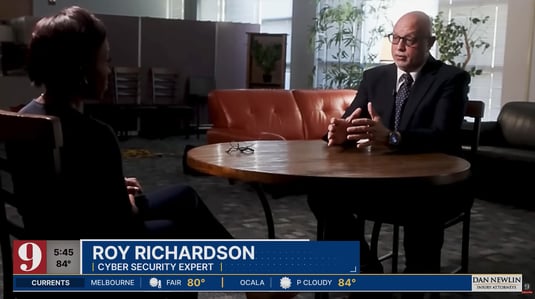
Recently Aurora InfoTech's Vice President and Chief Security Officer Roy Richardson was interviewed on WFTV Channel 9 with Emmy Award-winning investigative reporter Daralene Jones.
Roy sat down with Daralene to talk about how AI is now being used to fabricate digital evidence convincing enough to land someone in jail. A story that caught many off-guard and a conversation the public needs to hear. One we are glad we had the opportunity to weight in on.
The Case That Brought This to Light
She did not expect her life to be turned upside down by text messages she never sent.
After ending a relationship, she came home to find her place damaged. She called 911. Her ex-boyfriend told deputies she had been violent. She was arrested on a domestic battery charge and placed under a no-contact order.
Weeks later, while she was in court for a hearing on that very case, she was arrested again. This time for allegedly violating the no-contact order. The evidence? Text messages that supposedly came from her phone.
The problem was that she never sent them.
Phone carrier records eventually proved it. Her ex-boyfriend had allegedly used an AI tool to generate fake messages designed to look like they came from her, complete with language meant to get her in trouble. A judge ultimately questioned why anyone would knowingly send a message that could get themselves arrested. The violation charges were dropped, and she was later found not guilty by a jury on the original charge.
But it took eight months to get there.
"No one verified the evidence," she said.
That right there is the whole story.
Watch Roy’s full interview here: The Hidden Threat of AI-generated Content
What Roy Had to Say
Our segment on WFTV Channel 9 covered a lot of ground, and Roy did not sugarcoat any of it. Here is a look at what stood out from the conversation.
Creating Fake Digital Evidence Used to Take Skill. Now It Does Not.
There was a time when fabricating a convincing text message thread or audio clip required real technical know-how. Specialized software. The right expertise. Most people simply could not do it.
That time is over.
"It used to be that you needed specialized people running specialized programs to do that type of thing," Roy explained. "Now, it's much easier."
Today, anyone with a basic subscription to an AI service can generate realistic fake messages, images, voice recordings, and video in a matter of minutes. The tools are affordable, widely available, and getting better every month. What caught a judge off guard in her case could look even more convincing tomorrow.
The Legal System Is Playing Catch-Up and Struggling
Courts are now facing a challenge they were never really built for. How do you evaluate evidence when the technology to fake it has outpaced the tools to detect it?
The National Center for State Courts put it plainly in a February 2026 report: AI-generated evidence is now a direct threat to public trust in the justice system, and current detection tools are not keeping up.
Roy spoke to this directly: "Even judges are coming back and saying, 'Hey, maybe pump the brakes a bit because we don't have the necessary skill sets. And judges and law enforcement officers to say, "We don't have the necessary skill sets to really deal with AI and the evidence that's generated by AI".
That is not a criticism of law enforcement. It is just reality. The legal system moves deliberately, and AI does not wait.
A Screenshot Is No Longer
Solid Proof of Anything
This might be the hardest part for people to fully absorb.
For years, a screenshot of a text message, an email thread, or a document felt like solid evidence. It came from a device. It looked real. Why would you question it?
Here is why. A realistic-looking fake can now be created in minutes using tools available to the general public. A message that appears to come from your phone. An email thread that mimics your writing style. A video that puts you somewhere you never were.
None of these things requires a hacker. They require an AI subscription and a motive.
So What Can be done?
Roy made clear that waiting for new laws or industry standards is not a strategy. Here is what makes sense to start doing right now, whether you are an individual or a business:
- Stop taking digital evidence at face value.
Whether it is an HR complaint, a contract dispute, or an internal investigation, a screenshot alone is not enough. Look for corroborating records, timestamps, carrier verification, or platform-level confirmation. - Talk to your team about this.
People need to know this threat exists. Employees who flag something that seems off are an asset. Permit them to question what they see. - Get a Cybersecurity partner who understands digital forensics.
If your organization handles sensitive data, legal matters, or regulatory compliance, having someone in your corner who can evaluate the authenticity of digital content is not optional anymore. - Build a paper trail that cannot be faked.
Use communication and documentation platforms that create verifiable, time-stamped records rather than relying on screenshots or copies that can be altered after the fact. - Check your cyber insurance.
AI-generated fraud and fabricated evidence are real threat vectors now. Your policy should reflect that.
"This Is Just the Beginning"
That is how Roy closed out the conversation. Not to scare anyone, just to be honest.
The case got attention because it was dramatic and had a clear victim. But for every case that makes the news, there are others quietly unfolding in offices, courtrooms, and HR departments where fabricated digital content is shaping decisions, and nobody is asking the right questions.
The work of protecting what is real starts long before a crisis happens.
Wrapping Up
Being invited onto WFTV Channel 9 to speak to this issue was an opportunity we did not take lightly. AI-generated threats are not theoretical anymore. They are showing up in real cases, affecting real people, and the gap between what is possible and what is being caught is still wide open.
At Aurora InfoTech, this is exactly the kind of threat we help our clients get ahead of. If you are wondering what your exposure looks like, or just want to have an honest conversation about where your organization stands, we are here.